
Physiological and morphological changes
Several lines of morphological evidence point to an increase in dietary quality with the origins of the human genus, Homo, and especially with its first unequivocal member [8], Homo erectus. The size of the tooth decreased and the proportion size of the gut also [15]. This can be due to an increase in consumption of higher-quality and more energy-dense foods. Those foods were easier to digest and required less mastication (due to the use of tools and afterwards the domination of fire as a tool for cooking). Aiello and Wheeler [16] postulated on 1995 the Expensive-Tissue Hypothesis that explains why our brain is larger than expected and the gut the other way around. If you want to know more about the hypothesis you can read the article here.
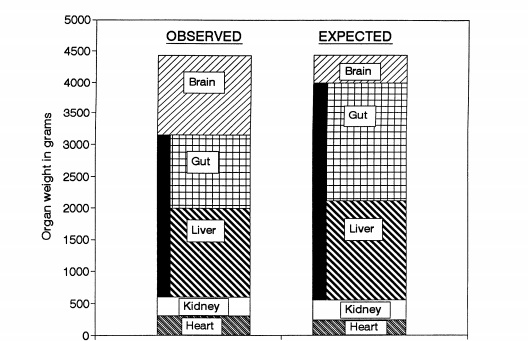
Figure 3. Observed and expected organ mass for a "standard" 65-kg human.(from Aiello and Wheeler [16])
Table 2. Observed organ mass of humans compared with their expected mass, on the basis of metabolic size, and the metabolic increments, associated with those differences. Adapted from Aiello and Wheeler 1995 [16]
|
|
Mass (Kg) |
|
|
|
|
|
Observed |
Expected |
Difference |
Metabolic increment |
|
Brain |
1,3 |
0,45 |
+ 0,85 |
+ 9,5 |
|
Gut |
1,1 |
1,88 |
- 0.78 |
- 11,5 |
|
Liver |
1,4 |
1,56 |
- 0,16 |
|
|
Heart |
0,3 |
0,32 |
- 0,02 |
- 0,6 |
|
Kidney |
0,3 |
0,24 |
+ 0,06 |
+ 1,4 |
Table 3. Relative gut volume proportions for some primate species (% of total volume) (Adapted from Milton 1987 [17])
|
Species |
Stomach |
Small intestine |
Caecum |
Colon |
|
Gibbon |
24 |
29 |
2 |
45 |
|
Orangutan |
17 |
28 |
3 |
54 |
|
Gorilla |
25 |
14 |
7 |
53 |
|
Chimpanzee |
20 |
23 |
5 |
52 |
|
Human |
17 |
67 |
0 |
16 |
On Australupithecus and Parantrophus we can see differences in the jaws and teeth. Robinson [18] suggested that Australupithecus stayed vegetarian while Parantrophus went hunting for meat. In the next image you can observe the differences on the face and mandibula,
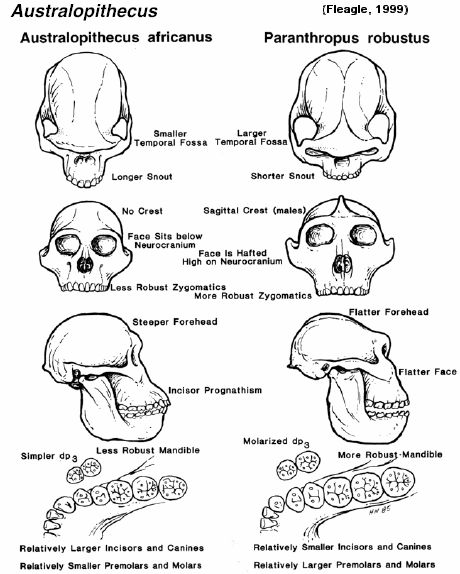
Figure 4. Comparative picture between Australupithecus and Parantrophus to show the differences.
Homo erectus (2Mya) showed facial shape changes and important decrease in molar tooth size pointing a move towards the modern human condition [13]. Facial shape changes and marked decrease in molar tooth size that emerged in Homo Erectus just after 2 million years ago indicating a move towards the modern human condition [13], not only because of the morphological changes but also change in the quality of foods.
The starting use of tools facilitated also niche differentiation. Simple tools can make a huge difference in the procurement and processing of foodstuff and gives a lot of advantage to the ones that know how to use them, and thus they need less specialized teeth or less strength in the jaw to eat. [19, 20]
The human digestive system follows the general primate plan in many ways, but the larger small intestine and the smaller large intestine suggest adaptation to a higher quality, or higher energy density, diet. Milton [21] argues strongly for the role of meat-eating as selective pressure for this changes starting around the time of H. erectus (1.8 M years ago) but is possible that increasingly processed, including cooked, food was an important contributor [20].
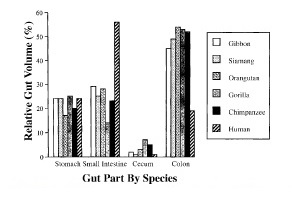
Figure 5. Relative fut proportions for extant hominoids (percentatge of total gut volume). See Milton [21]